

Search
Search for a symbol or emoji...
Body Type Calculator
Body shape: Hourglass
Waist-hip ratio (WHR): 0.67
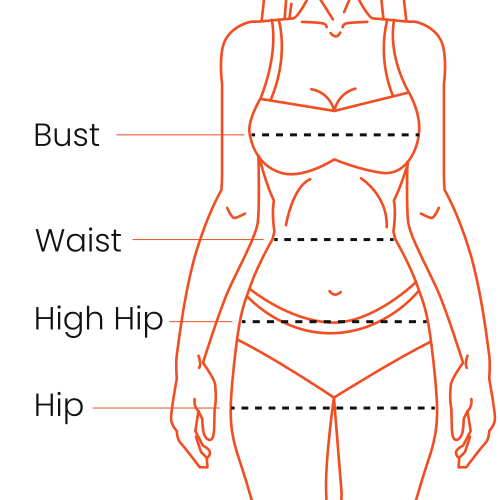
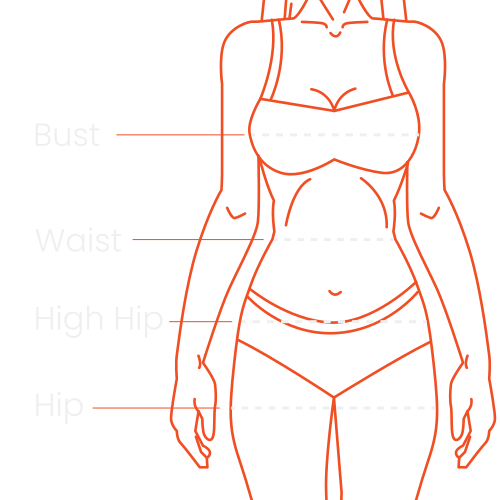
When measuring, stand straight with arms to the side. Keep the tape snug against the body without compressing soft tissue.
Body-shape categories are descriptive and style-oriented, not a medical diagnosis or ideal.
WHR is calculated as waist divided by hip. Higher WHR can indicate greater central fat distribution risk in some populations.
Body Type Calculator: Body Shape Classification and Waist-Hip Ratio (WHR)
How to use
- Choose one unit system (cm or inches) for all measurements.
- Enter bust, waist, high hip, and hip circumferences.
- Review body shape and WHR result.
- Use category output for clothing fit strategy and WHR for additional context.
- Re-measure periodically to track changes over time.
Formula and method
WHR = waist / hip. Body-shape class is determined by threshold comparisons among bust, waist, high hip, and hip differences.
Complete Guide
What a body type calculator does
A body type calculator classifies body-shape patterns using a small set of circumference measurements: bust, waist, high hip, and hip. The result is a descriptive shape label such as hourglass, triangle, rectangle, or inverted triangle. These categories are used mostly for clothing-fit strategy and visual proportion analysis, not for diagnosis.
This tool also provides waist-hip ratio (WHR), which is calculated by dividing waist circumference by hip circumference. WHR is often used in health-risk research as a proxy for fat distribution pattern. While body-shape category is primarily style-oriented, WHR may offer additional context for health conversations when interpreted alongside other measures.
The calculator is designed as a practical planning aid: enter measurements in either centimeters or inches, view category output instantly, and use the result to guide fit choices, tailoring, and proportion-aware outfit planning.
How body-shape classification works in this calculator
The classification logic compares differences between bust, waist, hip, and high-hip measures. Rather than using one threshold, it checks multiple conditions to identify proportional patterns. This mirrors the way many fashion-focused systems define shape families.
For example, hourglass-related classes typically require stronger waist contrast plus closer bust-to-hip balance, while triangle classes usually reflect relatively larger hip dimensions compared with bust. Inverted triangle generally indicates larger bust or shoulder-line dominance compared with hips, and rectangle indicates lower contrast between upper body, waist, and hips.
No classification model is perfect for all bodies. Human proportions exist on a continuum, and many people sit near category boundaries. For this reason, treat the output as a fit-planning shortcut, not as identity or judgment.
Understanding waist-hip ratio (WHR)
WHR is computed as waist divided by hip. A lower value usually indicates more hip-dominant distribution; a higher value indicates more central distribution. In population studies, higher central fat distribution can correlate with elevated cardiometabolic risk. However, WHR is still a screening metric and should not be interpreted alone as a diagnosis.
WHR can be influenced by measurement technique, hydration, breathing state, and tape placement. To improve reliability, measure at consistent anatomical points, keep posture upright, and repeat each measurement at least twice. Use average values when possible.
For personal tracking, trend direction over time can be more informative than one isolated value. If WHR changes alongside weight, waist circumference, and lifestyle habits, interpretation becomes more meaningful.
How to measure correctly
Bust is measured around the fullest chest point. Waist is measured at the natural narrowest point, typically above the navel. High hip is measured around the upper pelvic swell below the waist. Hip is measured at the fullest gluteal circumference. Tape should be level, snug, and not compressive.
Measurement error is the most common cause of unstable classification. If results seem inconsistent, re-measure with the tape parallel to the floor and maintain neutral breathing. Avoid post-workout fluid shifts and tight clothing when measuring.
Use the same unit across all fields in a session. This calculator supports cm and inches with internal normalization, but mixed or incorrect entries can still cause unrealistic output.
Using body shape output for clothing fit
Body-shape labels can help prioritize garment structure. Hourglass and related shapes often benefit from defined waist lines and proportional balancing. Triangle patterns may prefer visual emphasis on the upper body, while inverted triangle patterns may choose silhouettes that add lower-body balance. Rectangle patterns often use waist definition and shape-building cuts.
The goal is not to force one style but to increase fitting efficiency. If you shop online, knowing your shape category can reduce trial-and-error and guide size-selection strategy between tops, bottoms, and dresses.
Tailoring remains powerful regardless of category. Even with a clear shape result, individual shoulder slope, torso length, and posture still affect fit. Treat the calculator as first-pass guidance and refine with real garment feedback.
Limitations and healthy interpretation
Body-shape calculators are descriptive tools. They do not define beauty, health status, or worth. Many healthy people do not fit neatly into one shape label, and category names can vary across systems.
WHR can contribute to risk discussion but should be interpreted with blood pressure, lipids, glucose markers, physical activity, sleep, and family history. If health concerns exist, clinician-led assessment is always the right path.
Use this tool for practical decisions: fit, tracking consistency, and body-proportion awareness. Avoid over-interpretation from one measurement day.
Practical notes
Boundary cases
If your measures are near thresholds, small tape differences can change category output.
Repeatability
Measure under similar conditions each time to make trend comparisons useful.
Use-case focus
Shape category is best used for fit and styling decisions, not identity or health diagnosis.
Limitations
- Descriptive output only, not medical diagnosis.
- Category systems are model-dependent and culturally variable.
- WHR should be interpreted with broader clinical context.
- Single-day measurement error can affect classification.
FAQ
Can my body shape change?
Yes. Body composition changes, training, and life stages can shift proportions over time.
Is one shape healthier than another?
Health cannot be concluded from shape label alone; use broader clinical metrics.
Why include high hip?
High-hip input helps distinguish some adjacent categories more reliably.
What if I don't match any category perfectly?
That is normal. Use the closest category as a practical fit reference.